
 In-house Made
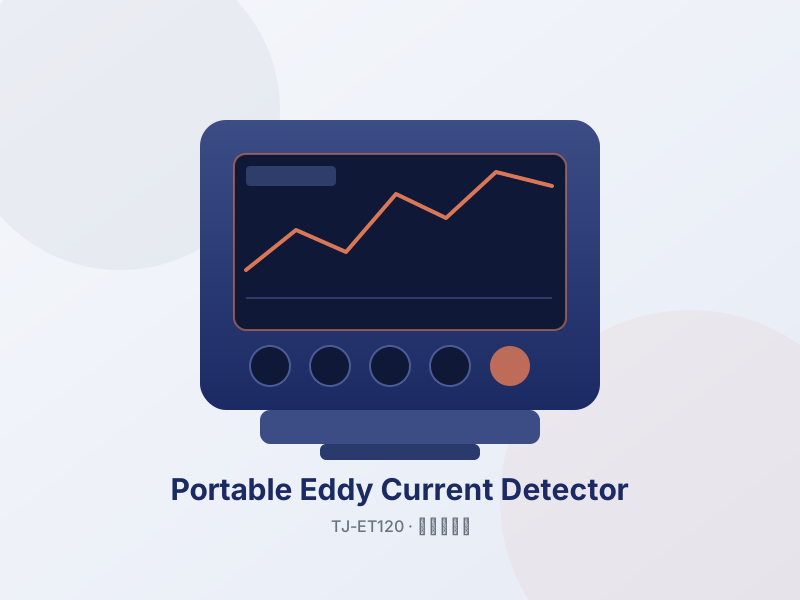
Portable Eddy Current Flaw Detector
Model: TJ-ET120 · Brand SKU: TJT-ET-120
Portable eddy current tester for surface and near-surface crack detection in conductive metals such as steel, aluminium and copper alloys, with impedance and phase display.
- Brand
- TJT Tester
- Model
- TJ-ET120
- Source
- In-house Made
- SKU
- TJT-ET-120
Learn more
Overview
The TJ-ET120 is a portable eddy current instrument for field inspection of surface and near-surface cracks in conductive metal components: machined parts, welds, tube and forgings.
It offers impedance display, phase display and combined impedance-phase views, and differential probes suppress background interference effectively.
Field practice
- Calibrate sensitivity on a reference block with an artificial notch
- Use lift-off compensation for stable probe contact
- Scan speed above 200 mm/s is not recommended; slow to 100 mm/s for critical welds
Specifications
| Test frequency | 20 – 1000 kHz |
|---|---|
| Display modes | Impedance / Phase / Impedance + Phase |
| Sensitivity | ≥ 100 dB/μ |
| Phase range | ± 360° |
| Probe types | Absolute / Differential |
| Lift-off compensation | 0 – 4 mm adjustable |
| Display | 4.3 inch colour LCD |
| Data storage | ≥ 1000 curves onboard |
| Weight | ≈ 1.2 kg |
| Protection rating | IP54 |
Key Features
- Impedance, phase and combined display
- Differential probe for noise rejection
- Reference block sensitivity calibration
- Lift-off compensation
- Portable design, IP54 rated
- Data recording and playback
Applications
FAQ
How deep can eddy current testing reach?+
Eddy current inspection targets surface and near-surface defects, typically effective to about 2–3 mm depending on conductivity and frequency. For deeper internal defects, use ultrasonic testing instead.
Does it require a conductive material?+
Yes. Eddy current works only on conductive materials such as steel, stainless steel, aluminium and copper alloys. Non-conductive materials require ultrasonic or magnetic particle methods.